
9 Practical Insights for a More Effective Cybersecurity Audit
Learn what a cybersecurity audit should cover, how to prepare, and how to turn findings into practical security improvements.
Published on · Craig Wheeler · How this article was made
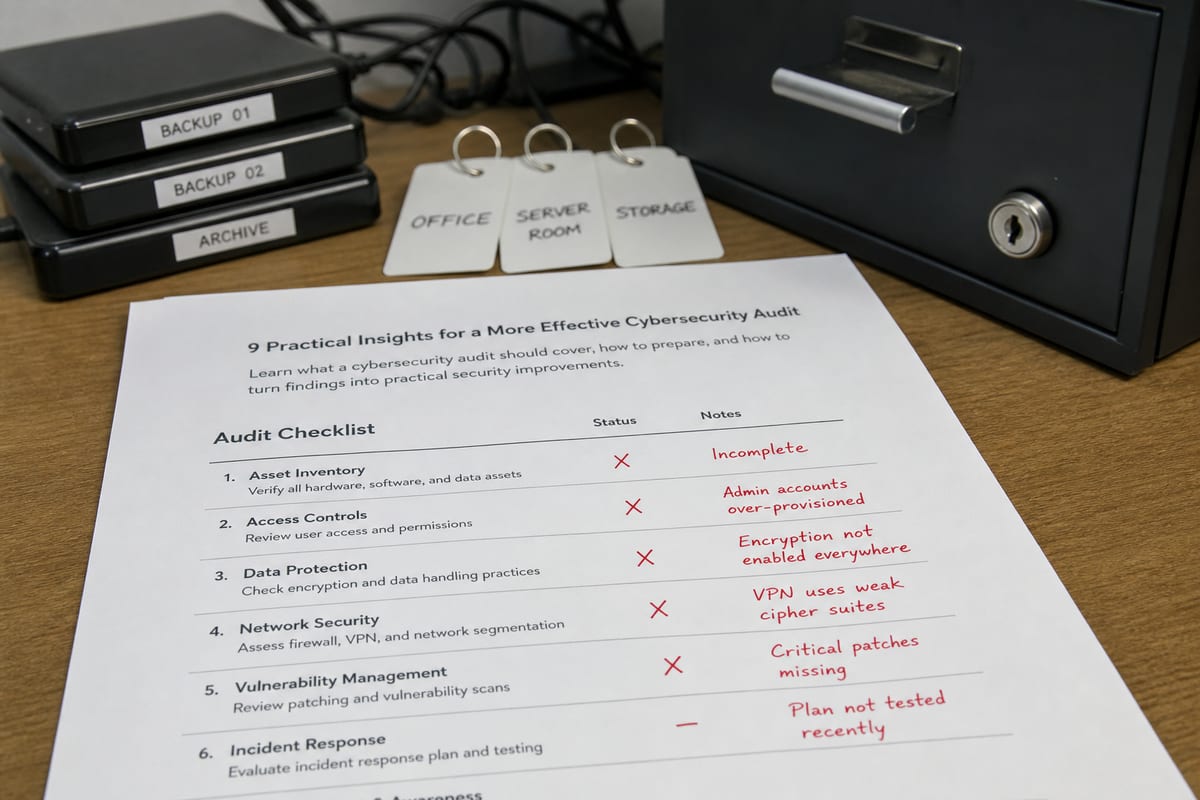
A cybersecurity audit can feel intimidating at first, especially if your team is already juggling daily operations, vendor relationships, compliance tasks, and a growing list of security tools. Many businesses hear the word “audit” and picture a stressful checklist exercise or a report that sits unread after delivery.
A good audit should do the opposite. It should help you understand how your systems, policies, and day-to-day habits hold up against real risk. It should show where your biggest exposures are, what is already working, and which improvements deserve attention first.
For most organizations, the real value is not in proving perfection. It is in getting a clear, honest view of your current security posture so you can make better decisions.
Start with the real purpose, not just the checklist
At its core, a cybersecurity audit is a structured review of your environment, controls, processes, and security practices. Depending on the scope, it may examine technical safeguards, user access, endpoint protection, backups, vendor risk, incident response readiness, cloud settings, policy documentation, and more.
That sounds broad because it is broad. Security problems rarely come from one single failure. They usually come from a combination of small gaps, such as outdated permissions, inconsistent patching, weak visibility, unclear ownership, or employees making reasonable mistakes in unclear situations.
An audit helps connect those dots.
It is also worth separating a cybersecurity audit from related activities. A vulnerability scan looks for known technical weaknesses. A penetration test simulates attacker behavior in a narrower way. A risk assessment evaluates threats, likelihood, and business impact. An audit often pulls from all of these ideas, but focuses on whether your controls and practices are appropriate, documented, and consistently followed.
If your organization is still working out where to begin, a cybersecurity risk assessment can help clarify priorities before you define a broader audit scope.
Scope makes or breaks the outcome

One of the most common reasons audits underdeliver is poor scoping. If the scope is too narrow, major risks stay hidden. If it is too broad, the process becomes slow, expensive, and hard to act on.
A useful scope usually answers a few basic questions:
- Which systems are in scope, such as servers, laptops, cloud platforms, firewalls, email, line-of-business apps, and remote access tools
- Which business units or locations are included
- Whether the audit is driven by internal governance, insurance, customer requirements, or a compliance framework
- Which time period and evidence sources will be reviewed
- Who owns follow-up actions after the audit is complete
This matters because different businesses face different exposures. A healthcare organization handling protected data will need a different lens than a manufacturer focused on operational uptime. A professional services firm with a remote workforce may need close attention on identity, email security, and device management. The right scope reflects how the business actually operates.
The strongest audits connect technology to business reality
Security reviews become far more useful when they move beyond a simple inventory of tools. Having endpoint protection, multifactor authentication, backups, or email filtering in place is important, but tools alone do not tell the whole story.
A meaningful audit asks tougher questions:
- Are security controls configured properly, or just turned on by default
- Are alerts reviewed consistently by someone accountable
- Do former employees lose access promptly across all platforms
- Are backup recovery tests happening on a schedule, not just backup jobs
- Can the business continue operating if a key system is unavailable for a day or two
- Do employees know how to report suspicious activity without hesitation
These questions bridge the gap between technical controls and operational resilience. That is where many hidden weaknesses live.
Policies matter, but only if they reflect actual behavior
Many organizations have security policies because they need them for insurance applications, vendor questionnaires, or compliance requirements. The problem is that some policies describe an ideal state that does not match daily practice.
An audit should test whether policies are realistic, current, and used. For example, it is one thing to say all devices are encrypted and centrally managed. It is another to confirm that every laptop, including those used remotely, is actually enrolled, monitored, and updated.
This is why interviews and process reviews matter alongside technical evidence. If leadership, IT, operations, and frontline staff all describe the same process differently, that inconsistency is a finding in itself.
Good documentation should support security, not perform security theater.
Common areas where audits uncover meaningful risk
Every environment is different, but certain patterns show up often across small and midsize organizations.
Identity and access control
Access sprawl is one of the most frequent issues. Users accumulate permissions over time, shared accounts remain active, and administrative privileges are granted too broadly. Audits often reveal that nobody has a complete view of who can access what.
This is especially important in cloud environments, where access can spread across Microsoft 365, line-of-business apps, file-sharing tools, VPNs, and remote management platforms. Reviewing identity controls usually includes multifactor authentication coverage, password policies, conditional access, privileged account use, and offboarding procedures.
Endpoint and patch management
Many companies assume devices are updated because updates are enabled. In reality, exceptions pile up. Remote laptops miss check-ins, legacy software blocks patches, and unsupported systems remain in use longer than planned.
An audit can show whether patching is consistent, measurable, and risk-based. It can also identify blind spots, such as unmanaged personal devices or systems that fall outside standard monitoring.
Email and user awareness
Email remains one of the easiest ways for attackers to reach employees. That does not mean staff are careless. It means people are busy, messages are convincing, and small moments of distraction are normal.
A thorough review should look at email authentication, filtering, impersonation protection, user training, and incident reporting habits. If employees are unsure what to do when something looks suspicious, that is a process problem, not just a training problem.
Backups and recovery readiness
Backups are often discussed as if they are the finish line. They are not. The real question is whether data and systems can be restored reliably, within a timeframe the business can tolerate.
Audits should examine backup coverage, retention, immutability where appropriate, access restrictions, and recovery testing. A backup strategy that has never been tested under pressure is still an open question.
Vendors and third-party access
Many businesses depend on outside platforms, software providers, consultants, and service partners. Each relationship can introduce risk through integrations, privileged access, shared data, or unclear responsibilities.
An audit can help clarify which vendors have access to sensitive systems, how that access is controlled, and whether contracts and internal processes reflect the real security expectations.
Evidence should be more than screenshots
A strong audit relies on evidence, but not all evidence carries the same weight. Screenshots can be helpful, yet they only capture a moment in time. More reliable evidence often includes configuration exports, access logs, policy records, asset inventories, ticket history, training completion records, and documented test results.
The goal is not to create paperwork for its own sake. It is to build confidence that controls exist, are functioning, and can be verified.
This is one reason audits can expose maturity issues that are easy to miss. A team may be doing the right things informally, but without consistency or proof. That can become a problem during compliance reviews, insurance renewals, incident investigations, or customer due diligence.
Why internal ownership matters before the audit begins
Even when an outside partner helps lead the process, internal ownership is still critical. Someone needs to coordinate access, gather evidence, answer process questions, and keep findings tied to business priorities.
Without clear ownership, audits tend to stall. Requests sit unanswered, technical teams work without context, and leadership receives findings that feel disconnected from operational reality.
Before the audit starts, it helps to define:
- An executive sponsor who can remove roadblocks
- A primary coordinator for scheduling, documentation, and follow-up
- Technical contacts for infrastructure, cloud systems, identity, and security tools
- Business stakeholders who can explain workflows and risk tolerance
- A method for tracking remediation after the report is delivered
This preparation does not just make the audit smoother. It increases the chance that findings lead to action.
The report is only useful if it helps you prioritize
One of the biggest frustrations with security reviews is receiving a long list of findings with little guidance on what matters most. Not every issue carries the same risk, cost, or urgency.
A useful audit report should help you distinguish between:
- Critical issues that create immediate exposure
- Structural weaknesses that raise long-term risk
- Process gaps that reduce consistency and accountability
- Documentation problems that affect compliance or insurability
- Lower-priority improvements that are worth planning, but not panic-inducing
This is where context matters. A missing control in one environment may be a major problem, while in another it may be partially mitigated by other safeguards. The point is not to minimize findings. It is to rank them in a way that supports sound decision-making.
For organizations that need help translating findings into an action plan, a security strategy conversation can be a practical next step.
Audits should lead to a roadmap, not a scramble
A mature response to audit findings is not to fix everything at once. It is to create a realistic remediation plan based on risk, effort, cost, and business impact.
That roadmap may include quick wins, such as tightening admin access or closing dormant accounts. It may also include longer-term projects, such as network segmentation, tool consolidation, policy updates, or formal incident response planning.
The best plans assign owners, define target dates, and identify dependencies. They also recognize that some improvements require change management, budget approval, or vendor coordination.
A cybersecurity audit is most valuable when it becomes part of an ongoing cycle of review, improvement, and verification.
Timing, frequency, and the question of “when should we do this?”
There is no single schedule that fits every organization. Timing depends on your industry, contractual obligations, growth stage, technology changes, and risk profile.
That said, certain moments are especially good times to conduct or refresh an audit:
- After major infrastructure or cloud changes
- Following a merger, acquisition, or leadership transition
- Before cyber insurance renewal or a compliance review
- After a security incident or near miss
- When remote work or device sprawl has expanded quickly
- When customers or partners begin asking tougher security questions
If nothing else, these moments tend to reveal how much your environment has changed since the last formal review.
A local perspective for businesses in the Daytona Beach area
For businesses in Daytona Beach and nearby communities, cybersecurity often intersects with practical operational realities, not just abstract risk models. Many local organizations rely on lean internal teams, a mix of cloud and on-premise systems, and outside vendors for line-of-business software, communications, or industry-specific platforms. That combination can create visibility gaps if nobody is regularly stepping back to review the full picture.
In the Daytona Beach area, weather events, distributed work, and recovery planning can also shape the conversation. A cybersecurity audit is not only about stopping threats, it is also about understanding whether your systems, access controls, and recovery processes hold up when normal operations are disrupted.
If you are reviewing broader resilience efforts, it can also help to look at how security oversight connects with IT monitoring services.
Final thought: clarity is the real deliverable
A cybersecurity audit is not just a technical exercise, and it should not feel like an exercise in blame. Done well, it gives you clarity about where you stand, where you are exposed, and what improvements will make the biggest difference.
If your current security picture feels fragmented, outdated, or hard to verify, an audit can give structure to the next steps. The goal is not to chase perfection. It is to reduce uncertainty and improve resilience in a way that fits your business.
Get in touch for a no-pressure conversation about your cybersecurity audit needs.