
What Strong Cybersecurity Looks Like for Businesses in Port Orange
Learn what practical, layered cybersecurity looks like for Port Orange businesses, from risk reduction to response planning.
Published on · Craig Wheeler · How this article was made
Cybersecurity is easy to talk about in broad terms and much harder to get right in day-to-day business operations. Most companies do not need more jargon. They need a clear picture of what protection actually looks like when employees are busy, systems are aging, vendors need access, and leadership still has to keep the business moving.
For businesses in Port Orange, that picture usually starts with a simple reality. Cyber risk is rarely just a problem for large enterprises. Local medical offices, professional firms, retailers, marine-related businesses, contractors, and growing multi-location companies all rely on email, cloud apps, payment systems, and connected devices. That means all of them have something worth targeting, whether it is customer data, login credentials, banking details, or simply access to a trusted inbox that can be used to scam someone else.
Port Orange has a business mix that makes this especially relevant. Along corridors like Dunlawton Avenue and around the Pavilion at Port Orange, many organizations depend on fast customer transactions, distributed staff activity, and third-party platforms for scheduling, payments, and communication. Those conveniences help businesses run smoothly, but they also create more entry points for attackers when security controls are inconsistent or outdated.
The real goal is resilience, not just prevention
A lot of cybersecurity conversations focus on stopping attacks entirely. Prevention matters, but a realistic strategy goes further than that. Strong protection means reducing the chances of an incident, limiting the damage if something gets through, and recovering quickly without chaos.
That is why effective cybersecurity is layered. One tool alone will not carry the load. Antivirus software, for example, can be helpful, but it is not a full strategy. Neither is a firewall, a password policy, or employee training by itself. Good security comes from multiple controls working together in a way that fits how your business actually operates.
In practice, that usually means looking at several questions at once:
- Who has access to what, and why?
- How are accounts protected beyond just passwords?
- What happens if a device is lost, stolen, or infected?
- How quickly would suspicious activity be noticed?
- Which systems are critical to operations?
- Are backups recoverable, current, and isolated from the same threat?
- What would employees do in the first hour of an incident?
If those questions do not have clear answers, the issue is not just technology. It is operational risk.
Where local businesses are often most exposed

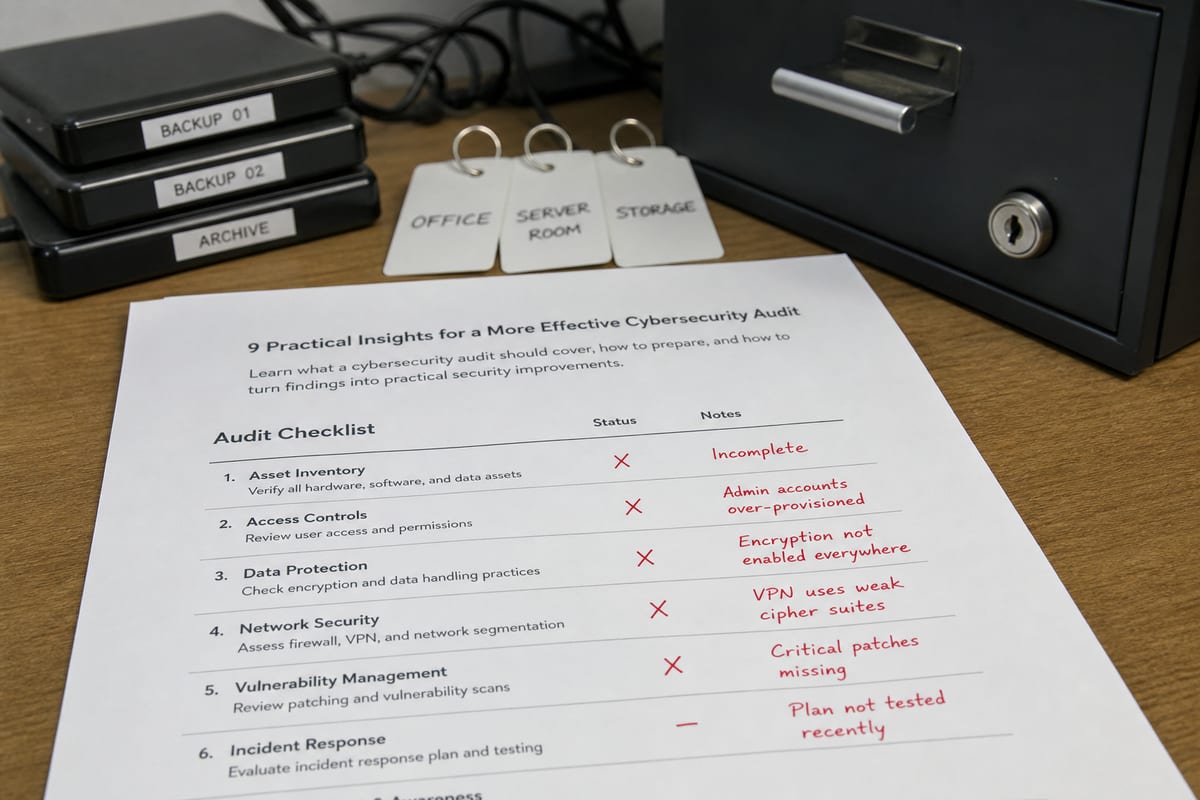
Many security gaps are not dramatic. They are ordinary decisions that accumulate over time. A former employee account stays active. A shared login gets reused. Software updates are delayed because nobody wants downtime. A vendor receives broad access that never gets reviewed. A finance employee trusts an email that looks like it came from the owner.
These are the kinds of weaknesses attackers count on. They do not always need sophisticated exploits if a business has weak identity controls or poor visibility.
Common exposure points include:
- Email-based phishing and business email compromise
- Weak or reused passwords
- Missing multi-factor authentication
- Unpatched computers, firewalls, or line-of-business applications
- Overly broad user permissions
- Insecure remote access methods
- Personal devices accessing business data without proper safeguards
- Backup systems that have never been fully tested
- Vendors with access to systems but no formal review process
For regulated organizations, the stakes are even higher. A security issue can quickly become a compliance issue, especially when sensitive records, payment data, or contractual obligations are involved. In those cases, businesses often benefit from structured compliance support services that help connect security practices to real-world requirements.
Email is still the front door for many attacks
For most small and midsize organizations, email remains the most common path into the business. That is not because employees are careless. It is because modern phishing is designed to look ordinary.
An attacker may impersonate a vendor, a shipping notice, a bank, a client, or a coworker. They may register a lookalike domain, insert themselves into an existing email thread, or send a message that creates urgency around payroll, invoices, or password resets. In a busy office, especially one handling lots of customer communication, that can be enough.
This is one reason Microsoft 365 security configuration matters so much. Many businesses assume that using a major cloud platform automatically means they are fully protected. In reality, the platform provides powerful security options, but those settings still need to be configured, monitored, and aligned with how the business uses the environment. If your team depends heavily on Microsoft tools, Microsoft 365 security and support can help close gaps that often go unnoticed.
Identity has become the new perimeter
Years ago, cybersecurity was often centered on the office network. Today, people work from laptops, phones, home offices, job sites, and cloud platforms. That shift has changed the security model. The most important control is often not the building or the firewall, but the identity.
In simple terms, if an attacker gets into a trusted account, they can often move through systems without needing to break in the old-fashioned way.
That is why strong cybersecurity usually includes:
- Multi-factor authentication across email, cloud apps, and remote access tools
- Conditional access policies for unusual sign-ins or risky locations
- Role-based permissions so employees only have the access they need
- Regular review of old accounts, shared accounts, and admin privileges
- Clear offboarding procedures when staff leave or change roles
This work is not glamorous, but it is one of the highest-value ways to reduce risk.
Security awareness training should match real workflows
Employee training often fails when it is treated as a checkbox. People tune out generic warnings, especially if they are not tied to the situations they actually face.
Useful training is specific. A front desk employee should know how to spot suspicious document-sharing requests. A finance team member should know how to verify payment changes. A manager should know what to do if a staff member reports a compromised password. A business owner should understand how easily a spoofed message can imitate an internal request.
The goal is not to turn every employee into a security specialist. It is to build habits that slow down risky decisions before they become incidents. Short, recurring guidance usually works better than one annual presentation everyone forgets.
Good endpoint protection is more than antivirus
Every laptop, desktop, and mobile device connected to your business creates both productivity and risk. If a device is compromised, attackers may gain access to files, saved credentials, cloud sessions, or internal systems.
Modern endpoint security typically includes several layers:
- Threat detection that goes beyond signature-based antivirus
- Device encryption in case hardware is lost or stolen
- Centralized visibility into health, updates, and suspicious behavior
- Application controls where appropriate
- Remote lock or wipe capabilities for mobile and portable devices
This matters for any organization with remote users, traveling employees, or shared devices. It also matters for businesses that have grown quickly and now have a mix of old and new hardware with inconsistent settings.
The network still matters, just in a different way
Even though identity and cloud access are central, network security still plays a major role. It is especially important for businesses with guest Wi-Fi, connected point-of-sale systems, smart devices, cameras, printers, or specialized operational equipment.
A secure network is usually segmented. Critical systems should not live on the same flat network as every other device. Guest traffic should be separated. Firewall rules should be reviewed intentionally, not just inherited from old setups. Remote access should be secured and limited.
Many businesses do not discover network sprawl until they start tracing how data actually moves. That is one reason periodic review matters. If you are unsure how your current environment is being watched day to day, responsive IT support can help surface practical issues before they become security problems.
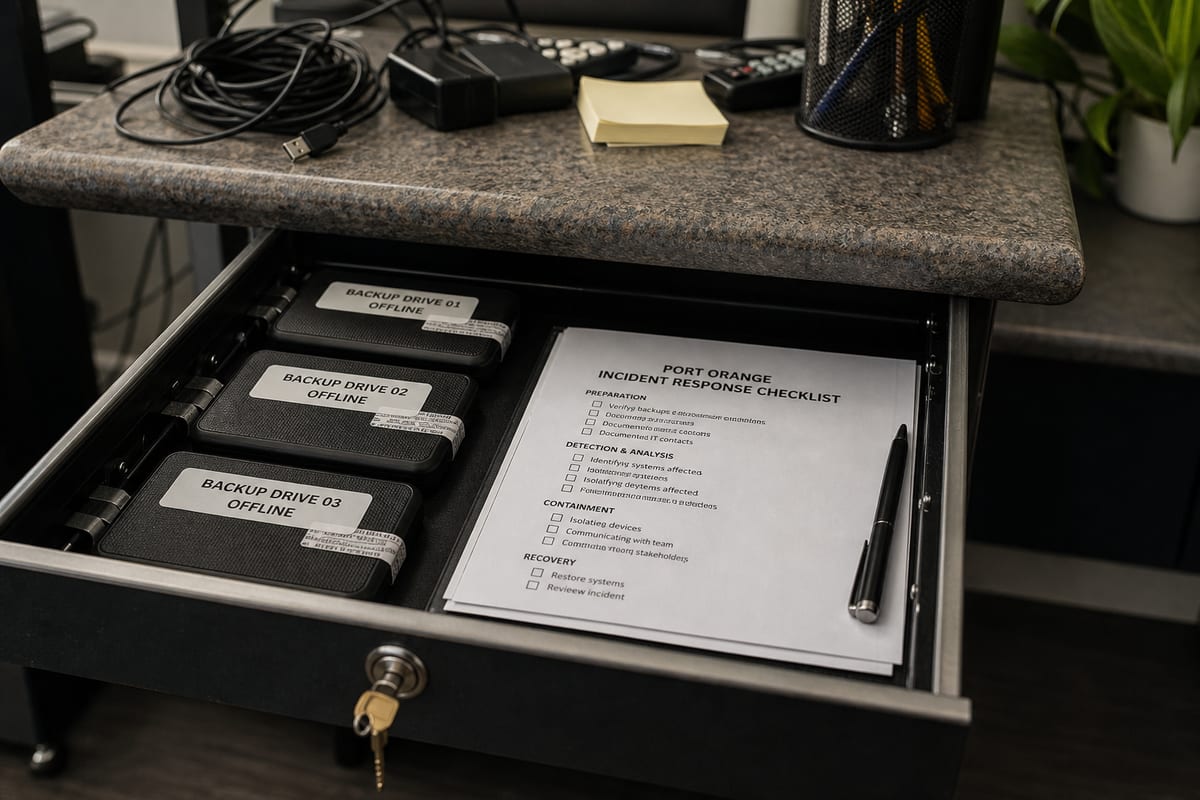
Backups are part of cybersecurity, not just disaster recovery
When ransomware hits, one of the first questions is whether clean backups exist and whether they can be restored quickly. Too many businesses assume they are covered because a backup job appears to be running. That assumption can be costly.
Reliable backup strategy involves more than copying files somewhere. It includes:
- Backup schedules tied to business importance
- Protection for servers, cloud data, and key workstations where needed
- Versioning in case encrypted files sync over healthy ones
- Separation from the primary environment so attackers cannot easily destroy backups too
- Regular restore testing, not just backup status checks
The test is simple. If a critical system failed tomorrow, how long would it take to get back to a workable state, and how much data could you afford to lose? Those are business questions as much as IT questions.
Compliance and cybersecurity overlap more than many teams expect
Some organizations treat compliance as paperwork and cybersecurity as technology. In reality, the two often reinforce each other.
Policies for access control, incident response, vendor management, retention, logging, and user onboarding are not abstract documents when they are done well. They are the operating rules that make security consistent. They help people know what is expected, how exceptions are handled, and what evidence exists if an audit or investigation occurs.
For businesses handling regulated information, a mature program often includes documented safeguards, risk assessments, staff training records, and repeatable review processes. That is where a deeper approach to compliance readiness and support can make security more organized instead of more burdensome.
Incident response is where preparation becomes visible
The quality of a cybersecurity program becomes very clear when something goes wrong. Without a plan, even a small incident can spiral into confusion. People are unsure whom to call, whether to shut down systems, how to preserve evidence, what to tell customers, or whether legal and regulatory obligations have been triggered.
A practical incident response plan should define:
- Who makes decisions during an incident
- How suspicious activity is reported internally
- Which systems are most critical to contain or restore first
- How outside experts, legal counsel, insurance contacts, or vendors are engaged
- What communication steps are needed for staff, customers, and partners
- How the business documents actions taken
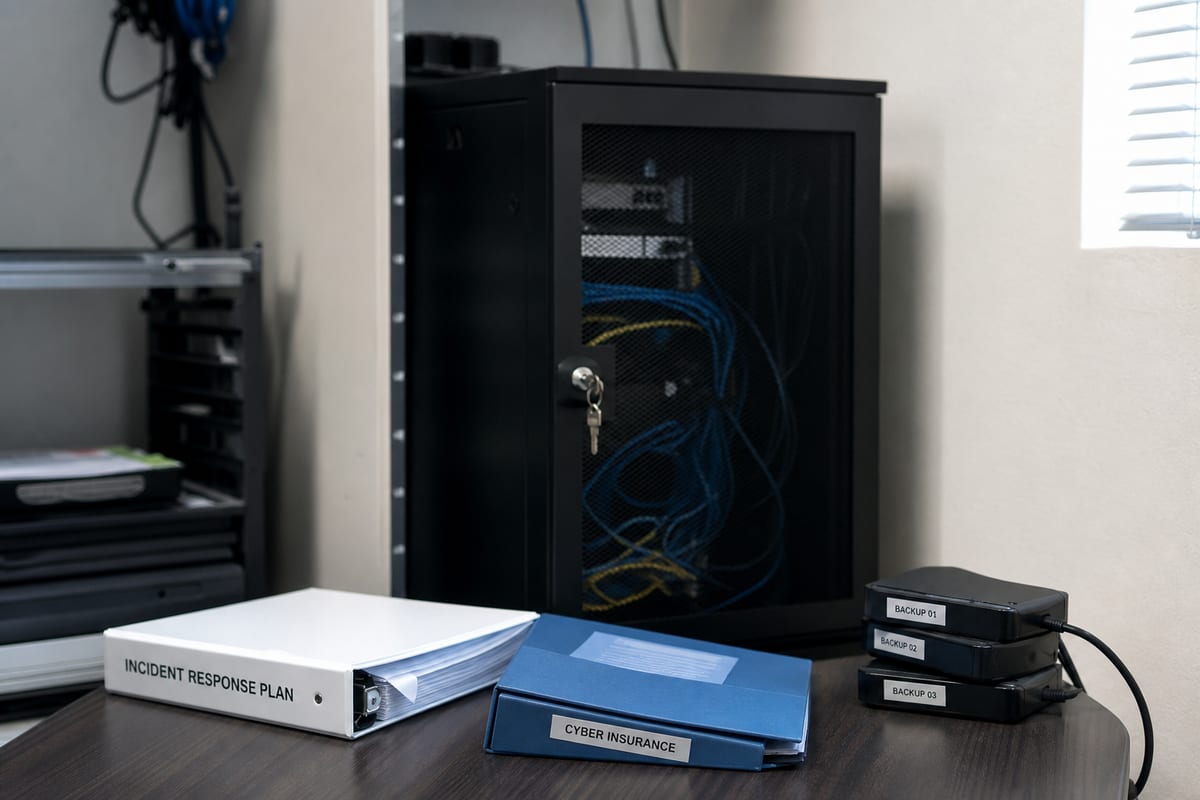
The point is not to create a binder that sits on a shelf. It is to reduce hesitation during the first minutes and hours, when decisions matter most.
What a right-sized security program looks like
Not every business in Port Orange needs enterprise-scale tooling. But every business does need a security approach that fits its size, risk, and operational complexity.
For a smaller office, that may mean getting the fundamentals right: multi-factor authentication, strong email protections, secure backups, patching, endpoint visibility, access reviews, and basic incident planning.
For a more complex organization, it may also include:
- Formal risk assessments
- Security standards for vendors and third parties
- Advanced logging and alerting
- Network segmentation across multiple locations
- Security controls for cloud platforms and mobile devices
- Documented compliance workflows
- Leadership reporting on security posture and priorities
The right level depends on what you store, how you operate, and what downtime or data exposure would actually cost your business.
Choosing a provider without buying fear
Cybersecurity sales language can be full of urgency, and some of that urgency is justified. Threats are real. But fear alone is not a strategy, and it should not be the basis for choosing a provider.
A strong cybersecurity partner should be able to explain risks clearly, prioritize improvements realistically, and connect technical recommendations to business outcomes. They should help you understand what matters now, what can be phased in later, and where your current exposure is most meaningful.
Look for conversations that include:
- Your business processes, not just your devices
- The kinds of data you handle
- How staff actually work day to day
- Your dependence on vendors and cloud services
- Recovery expectations if systems go down
- Any industry or contractual requirements you need to meet
That kind of discussion usually leads to smarter decisions than a one-size-fits-all security package.
Strong cybersecurity is not about chasing every new headline. It is about building dependable layers that fit your business, reducing avoidable risk, and being ready to respond when something does not go as planned.
If your business in Port Orange is unsure where its biggest security gaps are, the best next step is often a practical review of access, devices, email protections, backups, and response readiness. Contact BlazeLink today to talk through cybersecurity services that make sense for how your business actually works.