
A Practical Guide to Managed IT Services in Deland
Learn how managed IT services can help Deland businesses reduce downtime, improve security, and get support that fits daily operations.
Published on · Craig Wheeler · How this article was made
For many businesses in Deland, technology problems are not just annoying, they interrupt customer service, slow down staff, and create risk that is hard to see until something breaks. Managed IT services are meant to solve that problem by giving you ongoing support, monitoring, maintenance, and security without requiring you to build a full in-house IT department.
In Deland, that conversation is a little more specific than it is elsewhere. Local businesses often balance the needs of a historic downtown business environment, professional offices, healthcare practices, and organizations connected to Stetson University and the surrounding community. That mix creates a real need for IT support that can handle everything from aging office infrastructure in older buildings to modern cloud access for hybrid teams.
Instead of treating this as a generic list of services, it helps to answer the questions business owners and office managers actually ask when they are trying to decide if managed support is worth it.
When does a Deland business usually need managed IT services?
Usually, the need becomes obvious when technology starts taking too much attention away from the business itself. That can look different depending on your company.
A law office may be dealing with recurring printer and workstation issues. A medical or dental practice may be worried about secure access, backups, and user permissions. A local retailer or professional services firm may simply be tired of waiting until something fails before calling for help.
Managed IT services make the most sense when:
- Your team loses time to recurring tech issues
- No one is clearly responsible for updates, security, and backups
- You rely on a few aging devices or network components that could fail at any time
- You need more predictable IT costs
- You want better cybersecurity without piecing together tools on your own
- Your business has grown beyond ad hoc support from a single freelancer or reactive break-fix help
If your staff is saying, “We keep dealing with the same problems,” that is usually the sign.
A clearer definition, what are managed IT services really?

At a practical level, managed IT services mean ongoing technology support delivered as a service, not just one-off repairs. Instead of only calling someone after an outage, you have a provider actively watching systems, maintaining devices, supporting users, and helping plan ahead.
That often includes:
- Help desk support for employees
- Device and server maintenance
- Network oversight
- Patch management and software updates
- Security monitoring
- Backup checks and recovery planning
- Vendor coordination
- Technology guidance for budgeting and upgrades
A good managed approach is not just about fixing tickets. It is about reducing the number of tickets your team has to open in the first place.
For businesses that want more proactive visibility into system health, IT Monitoring Services can help catch issues early, before they turn into downtime.
Is managed support a fit for smaller companies in Deland, or only larger organizations?
It is often a stronger fit for small and midsize businesses than for large enterprises.
Larger organizations may have internal IT teams with specialized staff for security, networking, and support. Smaller companies in Deland usually do not have that luxury. They may have one office manager handling technology questions on top of ten other responsibilities, or a business owner making IT decisions without enough time to compare tools, vendors, and risks.
Managed IT services can give smaller organizations access to a broader skill set without the cost of hiring multiple full-time specialists. That matters for firms that need dependable support but do not need a full internal department every day.
It can also be especially useful in Deland’s mix of long-established local businesses and growing professional offices, where systems may have expanded gradually over time rather than through a formal IT plan.
Which services matter most day to day?
The most valuable services are usually the least flashy ones, the work that keeps your business stable every day.
Help desk support that people will actually use
When employees cannot log in, access files, print, connect remotely, or use core software, they need a fast answer. Reliable IT support for everyday issues keeps small frustrations from becoming larger workflow problems.
Monitoring and maintenance in the background
Routine updates, patching, storage checks, antivirus oversight, and performance monitoring are easy to postpone when no one owns them internally. Managed service providers handle that ongoing maintenance so problems are less likely to build up quietly.
Security as part of normal operations
Cybersecurity should not be treated as a separate project that only comes up after an incident. Account protections, endpoint security, user access controls, phishing defenses, and response planning all need to be part of daily IT management.
Backup verification and recovery planning
Having backups is not the same as knowing they will work when you need them. Managed support should include regular oversight of backup status and a realistic plan for restoring systems and data.
Strategic guidance
Good support is not only reactive. It should help you answer questions like: Which computers need replacement this year? Is our Microsoft 365 setup secure? Are we paying for overlapping tools? What should we budget for next?
Why does local context matter in Deland?
Because business technology is shaped by the place where it operates.
Deland is not just another office market. It has a distinctive downtown with older commercial buildings, and those spaces can come with network layout challenges, limited cabling paths, or infrastructure that has been adapted over time rather than designed for current technology needs. A provider working with businesses in Deland should understand that not every office starts with a clean, modern setup.
The city is also influenced by Stetson University, which contributes to the local business ecosystem through education, events, professional services, and a steady flow of organizations that need reliable connectivity, collaboration tools, and secure data handling. That creates a different support environment than a city built mostly around warehouses or tourism alone.
Local familiarity does not replace technical skill, but it does make planning, onsite support, and practical troubleshooting more effective.
How can you tell if your current IT setup is too reactive?
Ask yourself a few straightforward questions:
- Do you only hear from your IT provider when something breaks?
- Are software updates inconsistent across devices?
- Is no one regularly reviewing backups, security alerts, or hardware age?
- Do employees use workarounds because recurring issues never fully get solved?
- Are technology decisions driven by urgency instead of a plan?
If the answer is yes to several of those, your setup is probably reactive.
Reactive support tends to cost more over time, not always in invoices, but in lost productivity, rushed purchases, employee frustration, and preventable security exposure.
Security concerns, should managed IT include cyber defense too?
Yes, absolutely.
A modern managed service plan should include cybersecurity as a core function, not an optional add-on that gets attention later. Even smaller businesses face phishing attempts, account compromise risks, weak password habits, and device vulnerabilities.
That does not mean every company needs the exact same stack or process. A professional office with sensitive client records may need a different level of protection than a small retail operation. But every business should have baseline protections, visibility into threats, and a response path when suspicious activity appears.
For companies that need stronger threat visibility and response support, managed detection and response services can add another layer of protection beyond standard maintenance.
Budgeting for managed services, what should a business expect?
The right way to think about cost is not just monthly spend. It is total business impact.
A cheaper arrangement is not really cheaper if it leads to more downtime, longer employee delays, weak security, or frequent emergency fixes. At the same time, not every business needs an expansive service package.
A useful provider should help scope support around factors like:
- Number of users and devices
- Complexity of your network and software environment
- Compliance or security requirements
- Need for onsite support
- Remote work or multi-location needs
- Age and condition of current systems
The goal is not to buy the biggest plan. It is to build the right level of support for how your business actually operates.
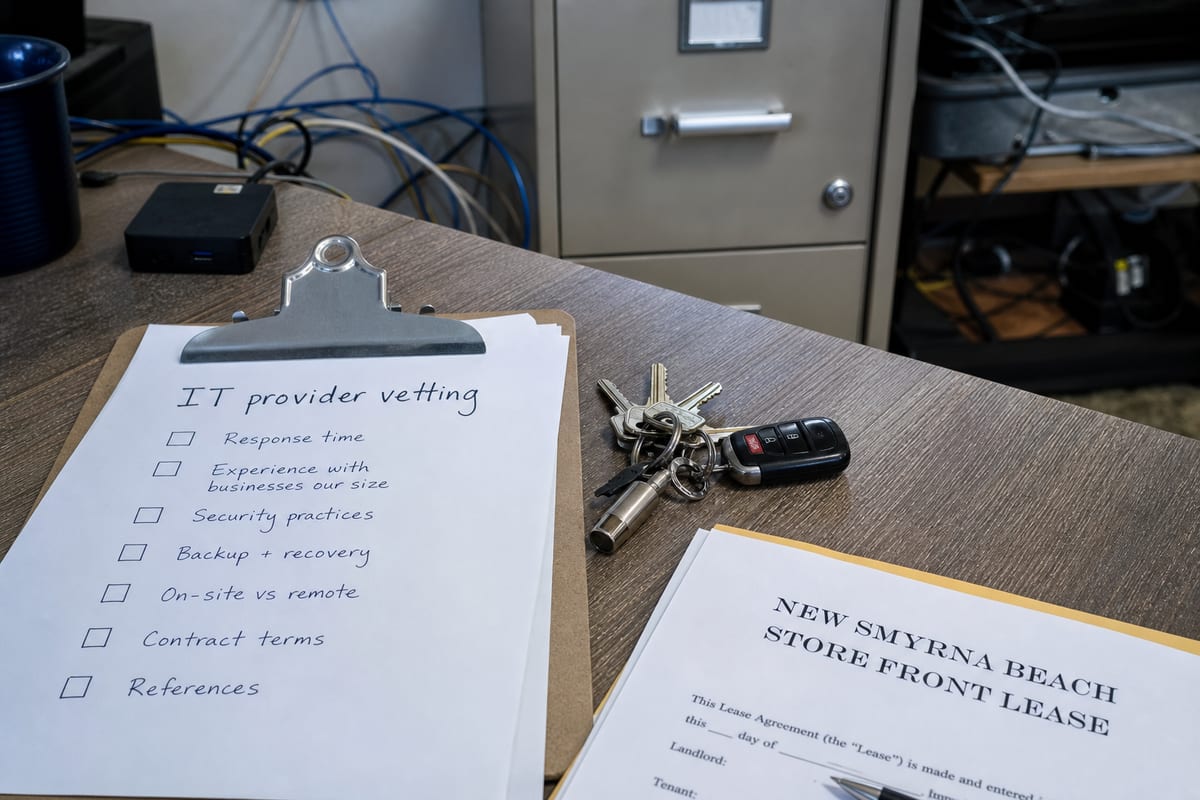
Choosing a provider, what questions should you ask?
This is where many businesses make the wrong comparison. They look only at price or response time and miss the bigger picture.
Ask questions like:
- What is included in ongoing support versus billed separately?
- How do you handle monitoring, patching, and preventive maintenance?
- What cybersecurity responsibilities are included?
- How do you document our systems and vendors?
- What happens if a server fails or an employee account is compromised?
- How do you help with long-term planning and budgeting?
- When do you recommend onsite visits?
- How do you communicate with non-technical staff?
You are not just hiring someone to fix devices. You are choosing a partner that will influence your operations, risk posture, and staff experience.
Can managed IT help if your business already has some internal tech support?
Yes. Managed services do not have to replace internal staff.
In some cases, they complement an in-house employee or small internal team by handling monitoring, escalations, cybersecurity tooling, after-hours coverage, or specialized project work. That can give your internal staff more time to focus on business applications, process improvements, or user training instead of chasing every password reset and hardware issue.
A co-managed approach can work especially well for organizations that have grown enough to need internal oversight, but still want outside depth and broader coverage.
Final thoughts for Deland businesses
Managed IT services are most valuable when they make your business easier to run, not more complicated to manage. The right provider helps reduce interruptions, improve security, support your staff, and bring more structure to decisions that often get pushed aside until something goes wrong.
If you are evaluating support options in Deland, focus on fit as much as features. Look for a team that understands your day-to-day environment, communicates clearly, and builds support around the way your business actually works.
Talk to our team about managed IT support built around how your business actually runs.